Eco and biodegradable packaging: myths and reality
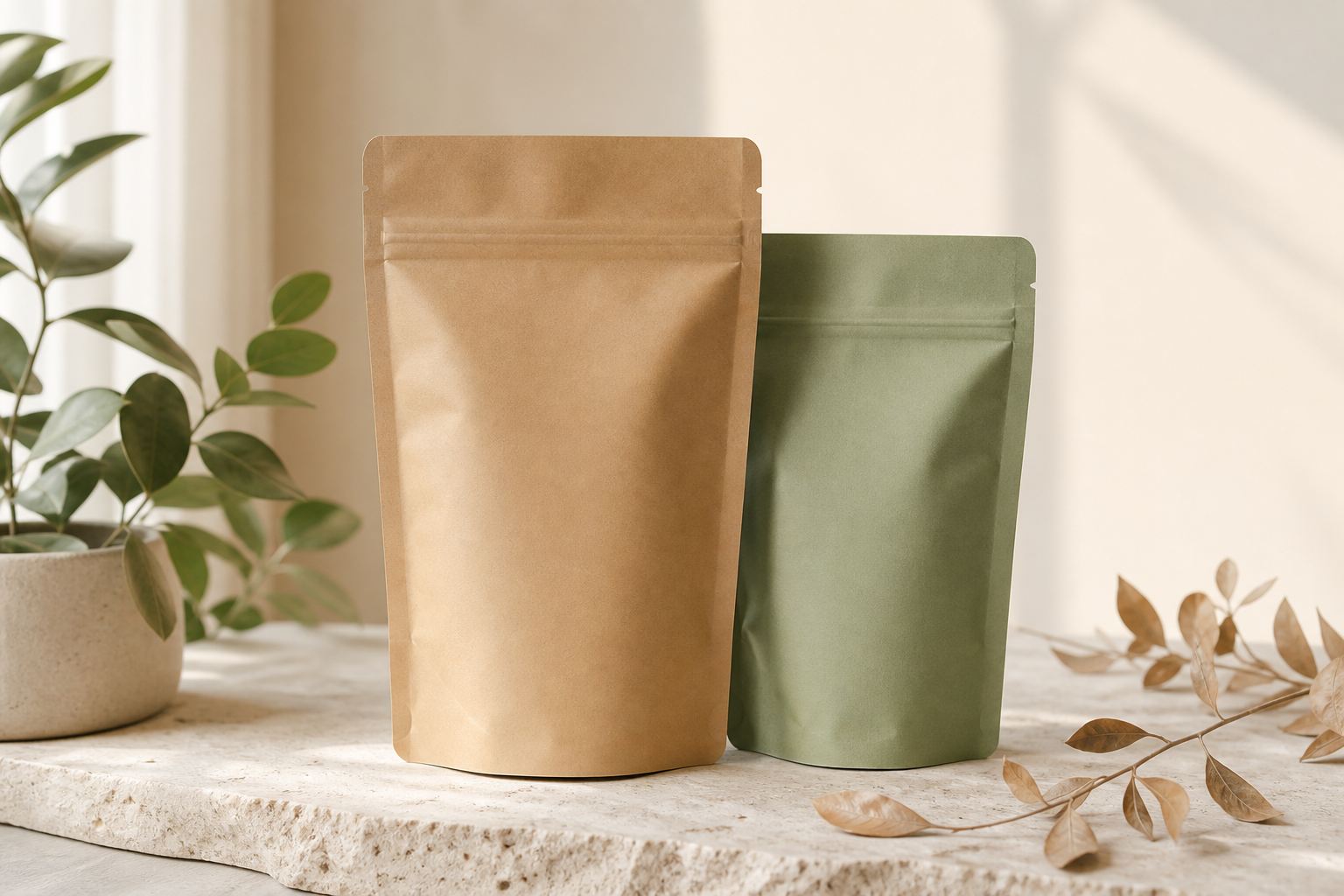
Words like "eco", "bio" and "degradable" look great on a pack, yet more often than not they hide marketing rather than real benefit. So let's be honest about it: what the key terms actually mean, what genuinely works today, and how to choose a responsible solution without greenwashing.
The most realistic path today runs through mono-material packaging (PE only or PP only) that is recyclable, and kraft with a thin barrier. Without certification, the terms "biodegradable" and "oxo" often mislead. Compostable only works where industrial composting exists. And the main trade-off never goes away: the stronger the barrier, the harder the recycling. We'll help you find the balance for your product.
What the terms mean
The confusion starts with the words. Here is what they actually mean:
- Recyclable the material can be recycled where the right infrastructure exists. For flexible packaging this is realistic mainly for mono-materials.
- Mono-material packaging made of a single type of polymer (for example mono-PE or mono-PP). It is far easier to collect and recycle than a mixed laminate.
- Compostable breaks down into compost under clearly defined conditions to a standard. It usually requires industrial composting, not a backyard pile.
- Biodegradable a vague term with no clear conditions or timeframe. Without a certificate it guarantees little.
- Oxo-degradable ordinary plastic with an additive that makes it break into tiny fragments. In many places it is restricted because it creates microplastics.
What actually works today
If you set aside the loud promises, a few genuinely working directions remain:
| Mono-PE / mono-PP | Recyclable structures from a single polymer, a good compromise for most products |
| Kraft with a barrier | A paper look plus a thin inner barrier, less plastic in the composition |
| Downgauging | Structure optimization: less material per pouch without losing function |
| Metallization instead of foil | Often lets you remove the aluminum layer and simplify recycling |
Every one of these directions is real, measurable and needs no invented promises. This is exactly what responsible packaging without greenwashing looks like.
Mono-materials and kraft: pros and limits
Mono-material laminates from PE or PP look like the most promising mainstream path right now. They keep the familiar doypack look, print in full color and still belong to a single recycling stream. Their barrier sits a little below a classic foil laminate, but for many products it is plenty.
Kraft with an inner barrier gives a natural look and cuts the plastic share, but on its own it does not make the packaging compostable: there is still a polymer or metallized layer inside. So it is an honest compromise between look and function, not a "fully natural" package.
The main trade-off: barrier versus recycling
The most important thing to grasp is that product protection and ease of recycling often pull in opposite directions. A multilayer laminate with foil protects superbly, yet it is almost impossible to recycle because the layers cannot be separated. A mono-material, by contrast, recycles easily but gives a weaker barrier.
So the honest choice is not "maximum eco at any cost" but a balance: pick the most recyclable structure that still delivers the shelf life your product needs. After all, a product spoiled by a weak barrier does far more harm to the environment than the packaging itself.
How to avoid greenwashing
- Demand specifics. "Eco" without explanation means nothing. Ask which material exactly and to which standard.
- Look for certificates. Compostability is confirmed by standards, not by a nice green label.
- Check the infrastructure. Compostable packaging is useless where there is no industrial composting.
- Avoid oxo additives. They create microplastics and are restricted in many countries.
- Assess the whole cycle. Sometimes a bit more plastic with reliable protection does less total harm than a spoiled product.
At Matrix Pack we work with a wide range of materials: PET, PE, PP, PA, aluminum, metallization and kraft, with layer thickness from 25 to 200 microns and a tolerance of plus or minus 5 microns. We will not promise a miracle package; instead we honestly pick the most responsible option for your product. Minimum order from 5,000 pcs, and we deliver across Ukraine.
Want responsible packaging without greenwashing?
We'll select a mono-material or kraft with a barrier for your product and budget. The quote is free.