Doypack sizes and volumes: how to choose
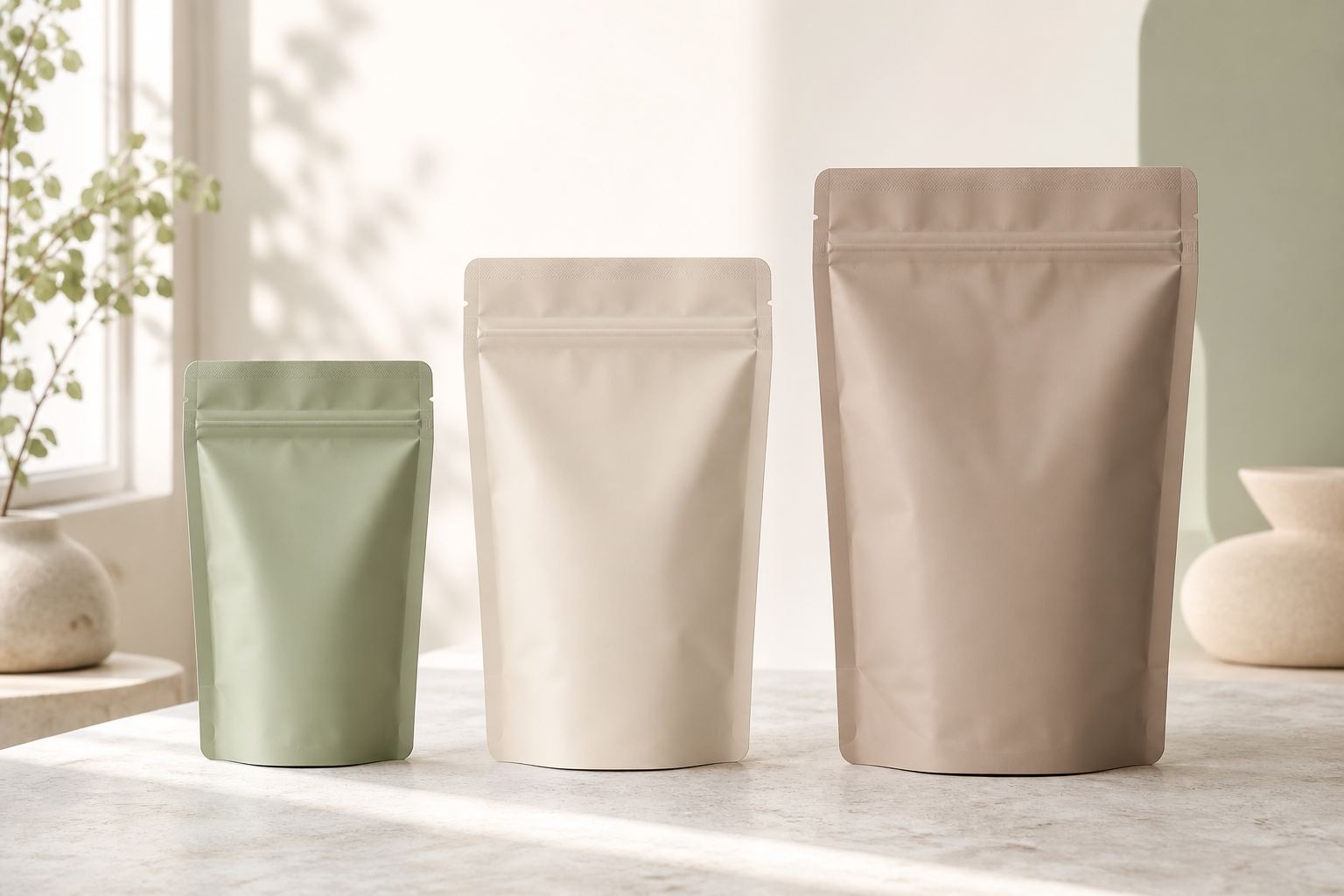
A doypack size is chosen not by weight but by product volume. That is why the same pouch holds a very different number of grams depending on density. Below you will find an example table for 100 g, 250 g, 500 g and 1 kg, an explanation of what the bottom gusset does, and tips on matching the size to your filling line.
One rule runs through everything here: volume first, weight second. The same weight of coffee and sugar ends up in different pouches, because coffee is lighter and fluffier. The bottom gusset adds capacity and stability, while width and height have to match your dispenser. Approximate sizes: 100 g, 110 by 185 mm; 250 g, 130 by 210 mm; 500 g, 160 by 250 mm; 1 kg, 200 by 300 mm. The exact figure we calculate by bulk density. Minimum order from 5,000 pcs.
Why size depends on volume, not weight
A pouch holds a certain volume, not abstract grams. How many grams actually fit comes down to the bulk density of the product. A simple example: a one-liter pouch holds about 400 g of ground coffee, yet almost a kilogram of sugar or salt. So the first thing we ask before choosing a size is the bulk density of your product.
Estimating the required volume is easy enough: divide the portion mass by the bulk density. Light, fluffy products (breakfast cereals, tea, snacks) ask for a larger pouch at the same weight than dense ones (nuts, legumes, powders). Only then, for the calculated volume, do we pick the specific dimensions and bottom gusset.
Table of approximate doypack sizes
Here are typical sizes for products of medium density. Treat them as a starting point: the final figures we still confirm against your product and a sample.
| 100 g (coffee, snacks) | Width 110 mm, height 185 mm, bottom gusset from 30 to 35 mm |
| 250 g (coffee, nuts) | Width 130 mm, height 210 mm, bottom gusset from 35 to 40 mm |
| 500 g (cereals, mixes) | Width 160 mm, height 250 mm, bottom gusset from 40 to 45 mm |
| 1 kg (pet food, groceries) | Width 200 mm, height 300 mm, bottom gusset from 50 to 80 mm |
| Tolerances | Usually from 2 to 3 mm in width and height |
How the bottom gusset affects capacity
The bottom gusset is the part that opens up and forms the base. Its width, more than anything, drives the capacity and stability of the pouch:
- A wider gusset: more volume and steadier standing on the shelf, but it also uses more film.
- A narrower gusset: material savings, though the pouch turns out thinner and holds less.
- The sweet spot: for most food products a gusset from 35 to 50 mm gives a good ratio of capacity to cost.
One more thing when choosing a gusset: look beyond volume and picture how the pouch will sit when full. A gusset that is too wide for a small fill leaves a lopsided, untidy shape.
Fitting a filling line and tolerances
If you fill on an automatic machine, the pouch has to meet the equipment's requirements: width for the grippers, height for the sealing zone, room for the zip-lock or valve. So it is best to name your line parameters right away. We build in tolerances (usually from 2 to 3 mm) so pouches run through filling reliably, without crumpling or skewing. And if you do not have a line yet, we will select a universal size for manual or semi-automatic filling.
What to send for an accurate calculation
- Product and portion weight: for example, coffee 250 g.
- Bulk density or a product sample so we can weigh the volume.
- The options you want: zip-lock, valve, euro slot, spout.
- Line parameters, if filling is automatic.
We will select a doypack size for your product
We calculate the volume by weight and density and agree on the gusset and tolerances. Design development is free.