Laminates for flexible packaging: PET, PE, PP, AL
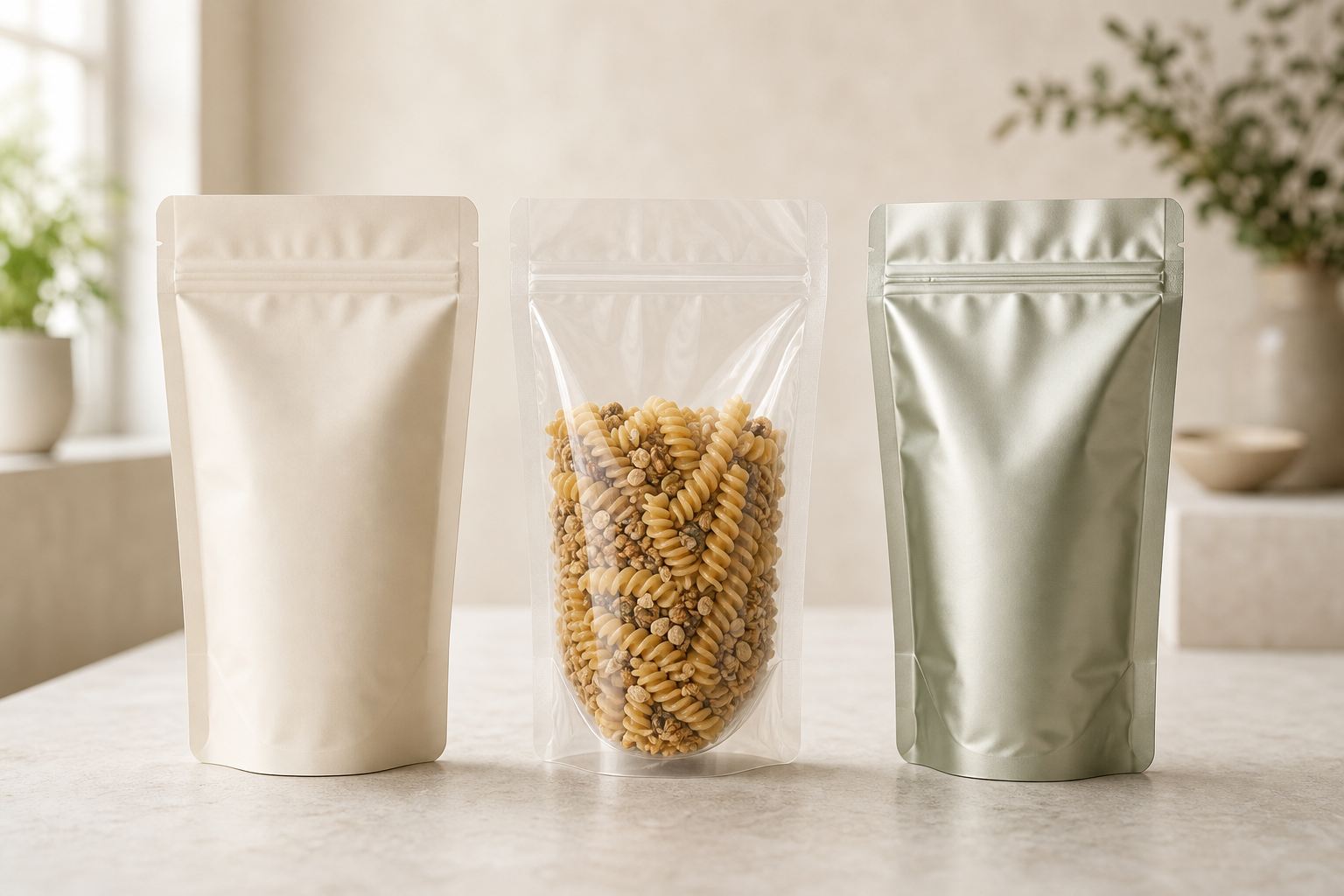
Look closely at almost any modern pack and what seems to be a single film turns out to be a laminate: several layers of different materials bonded into one web, each doing its own job, from printing and strength to barrier and sealing. Below we break down what goes into a laminate, what PET, PE, PP, PA and aluminum actually do, and how to build the right structure for your product.
A laminate stacks several layers, each with one job: the outer PET carries print and strength, the inner PE makes the seal, PA adds puncture resistance, and aluminum or metallization delivers the maximum barrier. The go-to structures are PET/PE, PET/AL/PE and kraft/PE. Layer thickness runs from 25 to 200 microns with a tolerance of plus or minus 5 microns.
What a laminate is and why layers matter
No single polymer can do everything at once: print well, hold its shape, block oxygen and still seal reliably. So manufacturers get clever and bond several materials into one laminate by dry lamination or extrusion. The result is a web with a clear division of labour: the outer layer handles looks and strength, the middle holds the barrier, and the inner takes care of the hermetic seal.
That is why a coffee doypack, a nut pouch and a retort pouch for a ready meal can look alike yet be built completely differently inside. Any well chosen structure always balances three things: product protection, cost and recyclability.
The role of each layer
So you are not lost when a supplier sends over a spec, it helps to know what each of the main materials is for:
- PET (polyester) works on the outside. It gives stiffness, gloss and scratch resistance and offers the best surface for high quality printing, plus it holds temperature and keeps its shape.
- PE (polyethylene) the inner sealant. Under heat it melts and forms a strong hermetic seal. It comes in different densities (LDPE, LLDPE), depending on how strong a seal you need.
- PP (polypropylene) the all-rounder: it can sit outside (BOPP for gloss or matte) or inside (CPP as a sealant), and it adds clarity and stiffness.
- PA (polyamide, nylon) adds mechanical strength and puncture resistance. It is the one you want for products with sharp edges and for vacuum packaging.
- AL (aluminum foil) or metallization the main barrier layer. It fully blocks light, sharply cuts oxygen and moisture ingress and, in turn, extends shelf life.
- Kraft (paper) an outer layer for a natural, eco look; it is always paired with an inner film, otherwise you can forget about a proper seal.
Table of layers and functions
| PET | Outer layer: print, strength, stiffness, scratch resistance |
| BOPP / PP | Outer gloss or matte, or inner sealant (CPP) |
| PA (nylon) | Puncture resistance, mechanical strength, vacuum packaging |
| AL / metallization | Barrier against light, oxygen and moisture, longer shelf life |
| PE (sealant) | Inner layer: hermetic seal, contact with product |
| Kraft | Natural look, outer layer paired with a barrier film |
Common laminate combinations
In practice, a handful of time-tested structures cover most orders:
- PET/PE a basic clear or printed structure for dry, undemanding products: snacks, confectionery, frozen goods.
- PET/AL/PE a full aluminum barrier for coffee, spices, dry mixes and anything with a long shelf life that needs protection from light and locked-in aroma.
- PET/MET-PET/PE a metallized version: barrier almost on par with foil, only cheaper and more flexible.
- PA/PE a strong structure for vacuum and products with sharp fragments.
- Kraft/PE or kraft/MET/PE a kraft look on the outside with the barrier tucked inside.
How to choose a structure for your product
Choosing a laminate always starts with one question: what is the product, and what does it need protecting from? A few pointers help from there:
- Sensitivity to oxygen and light. Coffee, nuts and dry cereals need an aluminum or metallized barrier. Candy, on the other hand, is often fine with a simple structure.
- Mechanical load. Sharp, heavy or vacuumed products require a PA layer.
- Heat treatment. Retort pouches need a special RCPP sealant that withstands a 121°C autoclave.
- Shelf life. The longer a product has to stay on the shelf, the stronger the barrier it needs.
- Ecology and recycling. If recyclability matters to you, look at a mono-structure based on PE or PP.
At Matrix Pack we work with all of these: PET, PE, PP, PA, aluminum, metallization and kraft, with layer thickness from 25 to 200 microns and a tolerance of plus or minus 5 microns. Minimum order from 5,000 pcs, and we deliver across Ukraine.
Not sure which structure suits your product?
We'll select the laminate, thickness and barrier for your product and budget. The quote is free.