Pet food packaging: barrier, strength and convenience
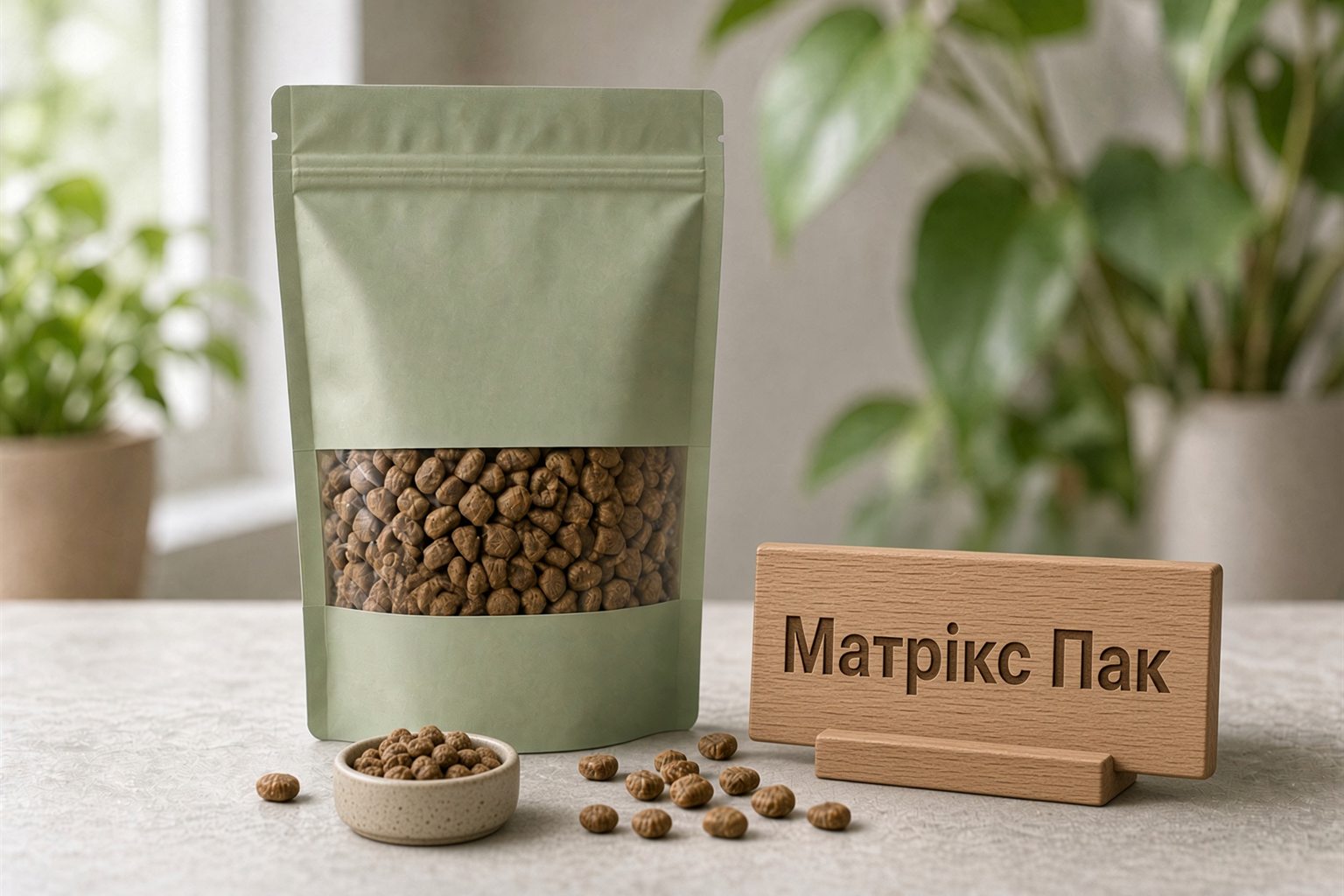
Pet food looks like a simple product, but its packaging is one of the most demanding. It has to hold a barrier against rancidity, keep a strong smell in, withstand sharp kibble and still stay convenient for large volumes, all at once. Let us look at what makes pet food packaging reliable.
Pet food packaging needs three things at once: a good oxygen barrier, because fats go rancid; strength against punctures from sharp kibble; and convenience for large volumes. So a barrier layer and a tough layer are added to the structure, and the format gets a reinforced zip-lock, a handle and often a flat base. For treats, smaller doypacks and sachets fit well.
Why pet food is a special product
Pet food has two traits that directly dictate the packaging requirements. First, it is fatty: both dry kibble and treats contain a lot of fat, and fats oxidize and go rancid in air. Second, it has a strong smell that owners do not want to notice at home, so the pack has to contain it. Add the typical shelf life of one to two years, and it becomes clear why a cheap thin film does not work here.
Barrier and freshness
The main enemy of pet food is oxygen. When it gets inside, the fats oxidize, a characteristic rancid smell appears and nutritional value drops. To prevent this over the whole shelf life, you need a reliable oxygen barrier. It is provided by structures with a low oxygen transmission rate: with metallization, aluminium foil or a barrier layer such as EVOH. This same barrier also keeps the smell inside so it does not spread around the room.
Strength: sharp kibble and heavy weight
The second challenge is purely mechanical. Dry kibble has sharp edges that press and rub the film from the inside, especially when the bag is large and heavy. A weak pack punctures or splits at the seal because of this. To avoid it:
- A tough layer is added to the structure, such as oriented nylon or PET, which gives puncture resistance without extra thickness.
- The seals and base are reinforced, because they take the weight of the product.
- The gusset construction is chosen correctly so the bag holds its shape and load.
This is especially important for large bags of several kilograms, where every seal works under constant pressure.
Formats and convenience for the buyer
Pet food is bought for the long term, so ease of use affects repeat purchase as much as the product itself:
| Large volumes | A flat-bottom pouch that stands firmly, with a reinforced zip-lock and a carry handle |
| Medium volumes | A doypack with a zip-lock, convenient for daily opening |
| Treats and wet food | Smaller doypacks, sachets and single-serve packs |
A reinforced zip-lock is no small thing here: it lets a large bag be closed tightly after every feeding, keeping freshness and holding in the smell.
The trend: recyclable pet food packaging
As in other industries, demand for recyclable packaging is growing in the pet food segment. Mono-material pet food bags that can be recycled are already appearing. The difficulty is the same: to combine recyclability with the high barrier a fatty, long-shelf product needs. So the solution is always chosen individually. Tell us what food you have, the fill volume and the shelf life you need, and we will select the film structure and format so the pack holds freshness, carries the weight and stays convenient for the buyer.
Need pet food packaging?
We will select the barrier, strength and format for your food and fill volume. Artwork design is free.