Mono-material: recyclable doypack and why your business needs it
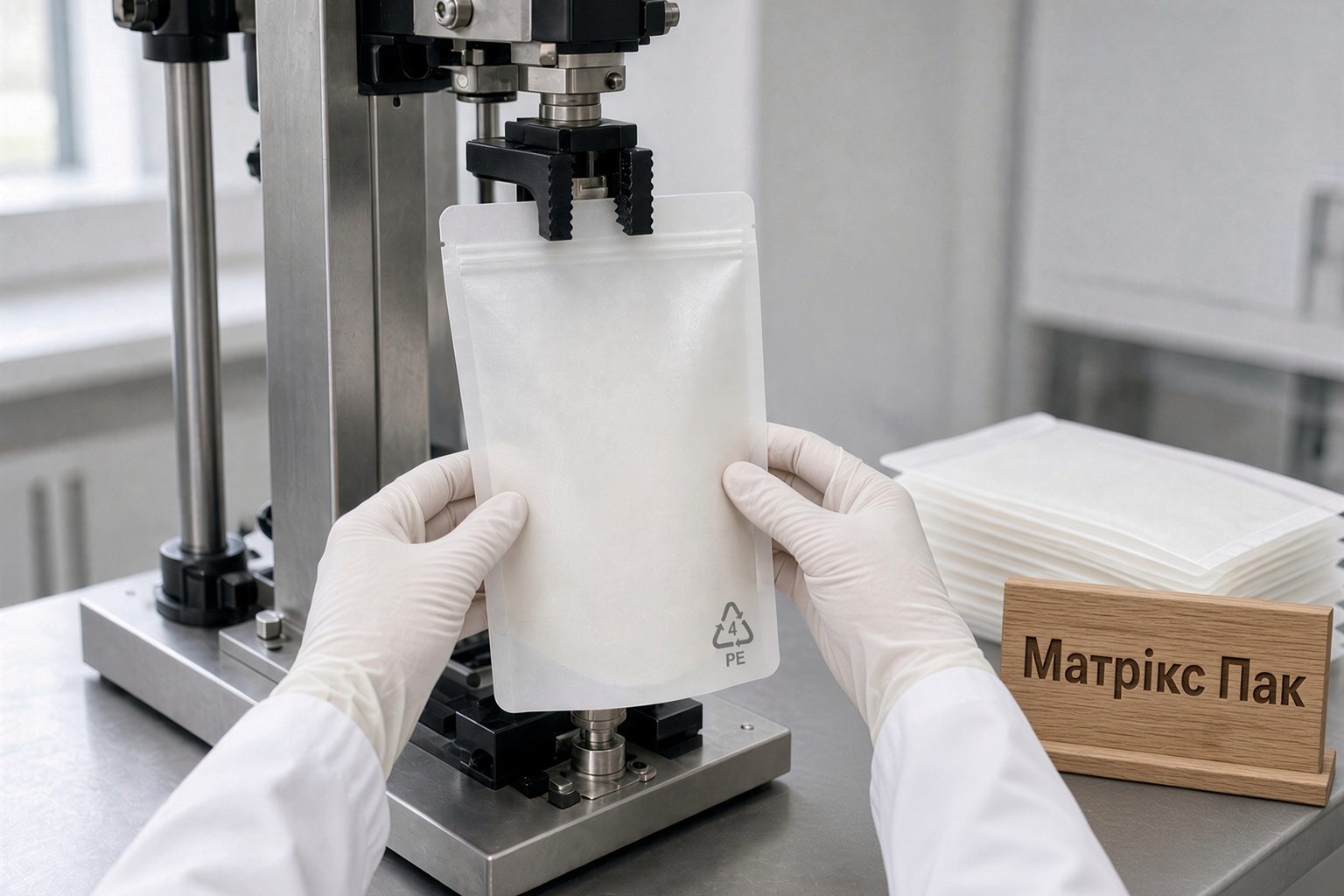
Brands increasingly ask for packaging that can be sent to recycling. But an ordinary barrier doypack is not built for that. Let us look at what mono-material is, why it can be recycled while a classic laminate cannot, and what to weigh if you are thinking about switching.
Mono-material packaging is made from a single family of polymers, most often entirely from polyethylene. It can be recycled together with ordinary PE film, whereas a multilayer laminate of PET, foil and PE cannot be separated. The barrier in a mono pouch relies on oriented polyethylene and a thin functional layer. It is still slightly more expensive, but recyclability requirements in the EU and in Ukraine make this direction unavoidable.
Why an ordinary doypack cannot be recycled
To protect a product from oxygen, moisture and light, the film is made in several layers. In a classic barrier laminate this is usually a combination of different materials: an outer PET for print and strength, a layer of aluminium foil or metallization for the barrier, and an inner polyethylene that seals. These layers are permanently bonded together.
The problem is that recycling works on a single-material principle. A line can recycle clean polyethylene or clean PET, but not their mix glued into one sheet. Such a laminate cannot be separated into its components, so even a consumer willing to recycle can do nothing: in most cases it goes to landfill or incineration.
What mono-material is
Mono-material packaging is a pouch made from a single family of polymers. Most often it is an all-polyethylene pouch (labelled mono-PE), less often an all-polypropylene one (mono-PP). The key idea is simple: if the whole pouch, including the film, the zip-lock and the adhesives, belongs to one polymer family, it can be accepted into the existing recycling stream for that polymer.
By industry benchmarks, in particular the guidelines of the European CEFLEX initiative on designing packaging for recycling, a pouch is considered suitable when it is more than 90 percent one polymer. A small share of other substances, such as inks or thin functional coatings, existing recycling systems can handle.
How to keep the barrier without foil
The hardest part of switching to mono-material is preserving product protection, since PET and aluminium used to do the barrier job. Several solutions make an all-polyethylene pouch possible without losing freshness:
- Oriented polyethylene (MDO-PE) replaces stiff PET: it gives the film strength and print stability while staying in the PE family.
- A thin barrier layer, such as EVOH or metallization on polyethylene, holds oxygen and moisture, but its share stays small, so the pouch keeps its recyclability.
- The inner PE sealant layer seals just as reliably as in an ordinary pouch.
For many products this barrier is entirely sufficient. To be honest, though, for the most sensitive goods with a very long shelf life an aluminium laminate still gives higher protection, so the choice is always made for the specific product.
Why your business needs it now
Recyclable packaging is no longer just an image question and is becoming a matter of market rules:
- The European Union has the Packaging and Packaging Waste Regulation (PPWR), which drives all packaging toward being recyclable. For exporters this is already a practical factor.
- Ukraine is rolling out extended producer responsibility: under the waste management law it is the companies that put products on the market in packaging who finance its collection and recycling. The logic is simple: whoever creates the waste pays for its treatment.
- Retail chains and large brands increasingly add recyclability to their own supplier requirements.
The practical takeaway: non-recyclable packaging will cost more over time through eco-fees, while recyclable packaging will win. So it is worth looking toward mono-material not when it becomes mandatory, but a little earlier.
What to weigh before switching
A few honest notes so the decision is a balanced one:
- Price. For now mono-materials are mostly more expensive than a classic laminate, because these are newer structures and smaller volumes. The gap is closing gradually.
- Barrier. For a very sensitive product you need to check separately whether a mono structure is enough, or whether it is wiser to keep a combined laminate for now.
- Real recycling. A pouch is recyclable only where there is somewhere to take it. So it matters not only to make mono packaging, but to label it correctly so the consumer knows what to do with it.
If you are thinking about recyclable packaging, tell us about the product, the shelf life you need and your target market. We will select a film structure for your barrier and budget, and tell you honestly where mono-material already works and where it is worth waiting.
Thinking about recyclable packaging?
We will select a film structure for your product, barrier and budget. Artwork design is free.