Seam integrity: what heat sealing of a pouch depends on
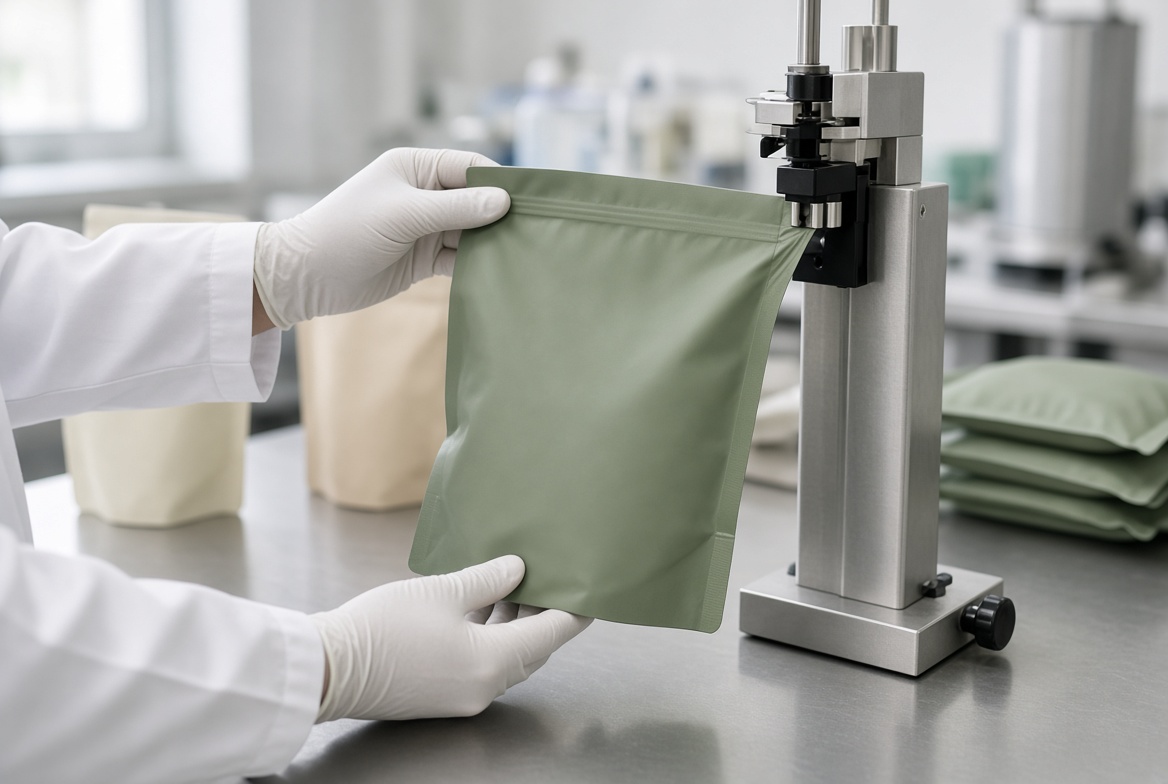
A pouch protects the product only as well as its seam holds. The welded seams are what keep the pack airtight, and that in turn keeps the product fresh for its full shelf life. Let us look, in plain terms, at how heat sealing works and what the quality of a seam depends on.
Heat sealing is the bonding of the inner film layers under heat, pressure and time. If even one of these three is set wrong, the seam turns out weak or leaky. We keep the film thickness stable within about 5 microns and check the seams of every batch, so the pouch protects the product for the whole declared shelf life.
What a welded seam is and why it matters
A flexible pouch is made from film that is folded and joined along its edges. Those joins are the seams. They hold the shape of the pouch, keep the product from spilling or leaking and, above all, isolate the contents from the outside. When a seam is made well, no air, moisture or foreign smells get inside, and the aroma and properties of the product are preserved.
So a seam is not a minor technical detail. It is the element that directly decides how long the product really stays fresh. Nice print and the right material will not help if the seam leaks.
How heat sealing works
Film for pouches is multilayer. The outer layers handle print, strength and barrier, while the inner layer (called the sealant) is made specifically to melt and bond. During sealing the two inner surfaces are pressed together and heated, they melt slightly, and after cooling they set into a single piece.
The quality of that bond rests on three things at once:
- Temperature: too little and the seam will not fuse, too much and the film can be burned or warped.
- Pressure: the surfaces have to meet tightly, otherwise microchannels stay between them.
- Time: the heat has to last exactly as long as the sealant layer needs to melt and set.
These settings are chosen for the specific film structure. What is ideal for a thin snack pouch will not suit a dense barrier laminate for coffee or a retort pouch for the autoclave.
The seams in a pouch
A typical doypack usually has several types of seam, and each has its own job:
| Bottom seam | Forms the standing base, carries the product weight and keeps the pouch stable on the shelf |
| Side seams | Join the walls and set the shape and volume of the pouch |
| Top seam | Made after filling, it finally seals the pouch with the product inside |
| Seam at the zip-lock | Fixes the closure and handles repeated opening without loss of tightness |
We deliver the pouch with the bottom and side seams already welded, and the customer makes the top seam on the filling line after the pouch is filled.
Why a seam can leak
There are only a few reasons a seam fails, and almost all of them are controllable:
- Temperature, pressure or sealing time set incorrectly.
- Unstable film thickness, with more material in one area and less in another.
- Contamination in the seal area: crumbs of product or dust that got between the surfaces during filling.
- A poorly matched sealant that does not hold the specific load or temperature.
- A line running too fast, so the seam does not have time to heat and set.
The first two are set at the film and pouch production stage, the last ones appear during filling at the customer. So a reliable result is always a shared responsibility of the material and the line settings.
How we watch over seam quality
On our side the key word is stability. We keep an even film thickness within about 5 microns, match the sealant to the product and the temperature range, and check the seams of every batch by eye and for tightness. For demanding products such as retort pouches for sterilization we add tear and leak tests, because there the seam has to survive an autoclave at around 121 degrees. If you tell us what you fill and on which equipment, we will choose the film structure so the seam holds reliably on your line.
Need packaging with a reliable seam?
We will match the film structure and sealant to your product and filling line. Design development is free.