Packaging for freezing: which films survive the cold
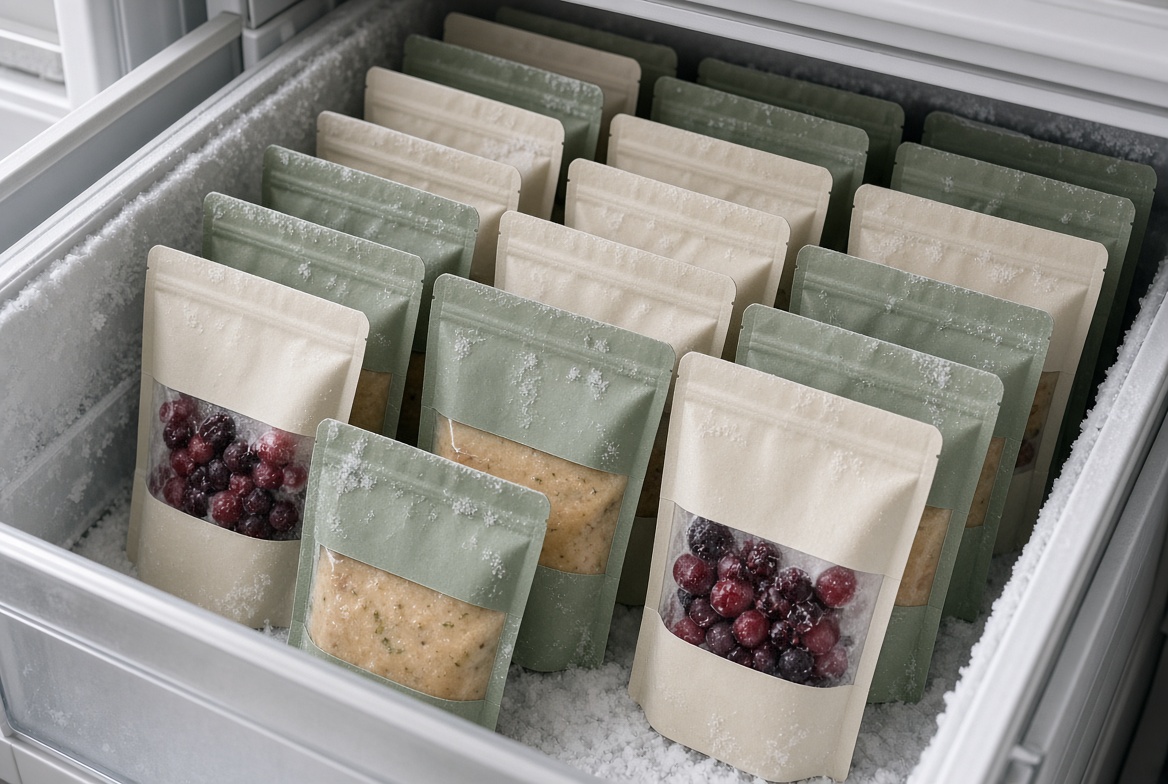
Freezing is a serious test for packaging. In the cold an ordinary film can turn brittle and a seam can crack, and the product loses both its look and its taste. Let us look at which materials really hold up to the cold and what to watch for when you order pouches for frozen products.
Freezing calls for a cold-resistant, flexible film that does not crack in the cold. Most often these are structures based on polyethylene (PE), and for puncture resistance polyamide (PA) is added. A barrier layer protects against freezer burn and loss of aroma, and a reliable seam keeps the pack airtight even in the freezer. The format is chosen for the product: a pouch, a doypack or film with a zip-lock.
What makes freezer packaging special
The main difference is that the material has to stay flexible at sub-zero temperatures. Many films stiffen in the cold and start to break at the slightest impact, especially when the pouch is full and is moved around inside the freezer. That is why freezing calls for special structures designed for the cold.
The second point is tightness. Moisture that gets inside turns into ice crystals, the product frosts over and suffers freezer burn, meaning it dries out and loses taste. A reliable barrier and a good seam prevent this.
Which films survive the cold
The material for freezing is chosen to combine flexibility, strength and the right barrier. Here are the structures that go into work most often:
| Polyethylene (PE) | The base for freezing, it holds low temperatures well and stays flexible |
| PA + PE (polyamide) | Polyamide adds strength and resistance to punctures from sharp or frozen pieces |
| PET + PE | A stronger structure with good print for retail frozen products |
| With metallization or AL | Maximum barrier for long storage without freezer burn |
In our work we have PE, PP, PET, PA, metallization and aluminium, so we build the structure for the specific product and storage temperature.
Barrier and tightness in the cold
The longer a product sits in the freezer, the more the barrier matters. Without it, oxidation and freezer burn slowly continue even at sub-zero temperatures. For short terms plain PE is enough, and for long storage a metallized layer or aluminium is added, which almost fully blocks moisture and oxygen. We pay separate attention to the seam: it has to stay airtight and not brittle, so the sealant is chosen specifically for low temperatures.
Formats for frozen products
- Flat pouches and lay-flat tubing: simple and economical for vegetables, berries and semi-finished goods.
- Stand-up doypack: a presentable shelf look for retail frozen products.
- Zip-lock: handy when the product is taken in portions and the rest goes back into the freezer.
- Euro slot: for hanging on retail equipment in the frozen aisle.
What to consider when ordering
Tell us what you freeze, to what temperature and for how long, and how you fill it: by hand or on an automatic line. This drives the film thickness, the structure and the type of seam. We will choose a cold-resistant material, print your design and prepare a trial quote for free. Minimum order is from 5,000 pieces, and lead time is usually 7 to 14 days.
Need packaging for freezing?
We will match a cold-resistant film and format to your product. Design development is free.